Bagasse vs Paper vs PLA vs Areca: Which Is Best?
A six-axis comparison of the four genuinely compostable tableware materials available in India — feedstock, home compostability, microwave behaviour, cost, scale, and aesthetics.
If you've spent time in the compostable-disposables aisle of any Indian sustainability brand, you've seen four materials: bagasse, paper, PLA cornstarch, and areca leaf. Each one is sold with the same marketing words ("eco-friendly", "natural", "compostable") and each one has different real properties — properties that matter for your use case.
This post is the head-to-head comparison, scored on six axes that actually drive a procurement decision.
The 6 axes
- Feedstock origin — where the raw material comes from
- Home compostability — does it actually break down in a Mumbai apartment compost bin?
- Microwave / hot-food behaviour — useful for daily meals?
- Cost vs plastic — the affordability gap that matters at scale
- Scale of supply — can a 1,000-guest event source it from one supplier?
- Aesthetic / cultural fit — which event does each one belong at?
The verdict, up front
| Axis | Bagasse | Paper (FSC) | PLA cornstarch | Areca leaf |
|---|---|---|---|---|
| Feedstock | Sugarcane waste | Wood / bamboo pulp | Corn or sugarcane starch | Areca palm leaves |
| Home compost | Yes — time varies | Yes — time varies | No — industrial only | Yes — time varies |
| Microwave | Yes — 3 min @ 700-1000 W | Variable (PE-lined fails) | No — deforms above 60 °C | Yes |
| Cost vs plastic | +30-60% | +20-40% | +40-80% | +60-100% |
| Scale | High (sugar surplus) | High | Low (mostly imported) | Low (cottage volume) |
| Aesthetic | Moulded fibre, neutral | Plain paper | Clear plastic-like | Natural leaf, premium |
The short version: bagasse wins on home compostability + microwave + scale. Paper wins for cutlery and small lids. PLA looks compostable but isn't, practically, in India. Areca wins for wedding aesthetics.
Bagasse, in detail
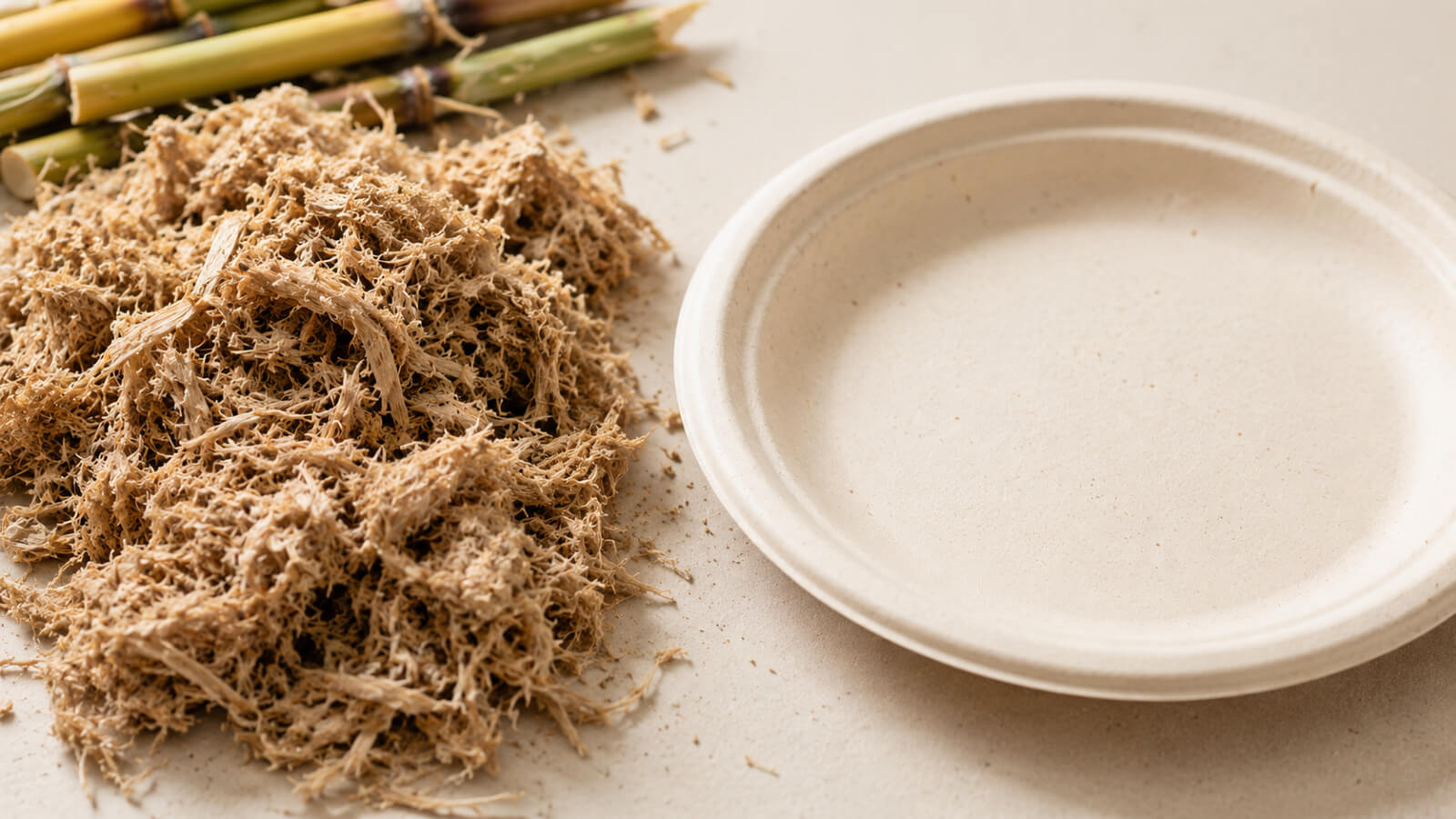
Bagasse is the fibrous residue left after sugarcane is crushed for juice. Indian sugar mills produce ~250 million tonnes of bagasse annually, more than the domestic packaging industry could absorb. The pulp is moulded under heat and pressure into plates, bowls, containers, trays, clamshells, and lids.
Strengths:
- Genuinely home-compostable (typically about 90 days in commercial composting) (BPI + EN 13432 certified)
- Microwave-safe at 700-1000 W for 3 minutes
- Naturally water-resistant without PFAS coating (the fibre density does the work)
- Scales — Indian sugar industry surplus means supply is reliable
- Works for the widest range of formats (plates, bowls, containers, clamshells, trays)
Weaknesses:
- Doesn't mould well at thin cutlery cross-sections — we use paper for forks/knives/spoons
- Slightly more expensive than PE-lined paper (the cheapest "compostable" alternative)
- Not as visually premium as areca leaf for high-end weddings
Use it for: plates, bowls, containers, clamshells, meal trays, dip cups. PulpyWare's main catalogue is bagasse.
Food-grade paper, in detail
FSC-certified paper at 600-800 GSM, no plastic coating, no PFAS. The compostable kind, not the PE-coated supermarket kind.
Strengths:
- Home-compostable (typically about 90 days in commercial composting) (faster than bagasse because the cross-section is thinner)
- The only material that gives knife-edge rigidity at single-use cutlery weight
- Works for small cup lids where bagasse can't reliably mould the thin profile
Weaknesses:
- Without coating, goes soggy quickly under oil or sauce — limits the format range
- For larger surfaces (plates, bowls), bagasse outperforms on rigidity
Use it for: cutlery (forks, spoons, knives), small cup lids, napkins.
PLA cornstarch, in detail
PLA — polylactic acid — is a bioplastic polymerised from corn or sugarcane starch. Looks like clear plastic; commonly used for cold cups, salad bowls, clear lids.
Strengths:
- Plant-based feedstock (corn or sugarcane)
- Clear-plastic-like transparency, useful where visibility matters
- Heat-stable enough for cold drinks
Weaknesses (the deal-breakers):
- Industrial compost only. PLA needs 60°C+ sustained temperatures with high humidity for 60-90 days to break down. Home compost bins don't reach this temperature. India has very few industrial composters that accept PLA[^1].
- Deforms above 60°C. Microwave a PLA cup with hot soup → cup collapses.
- Persists in landfill. PLA in landfill takes decades to break down — significantly slower than virgin paper.
The practical Indian reality: PLA is functionally a marketing label. The compostability claim is technically true (in industrial conditions) and substantively misleading (because those conditions don't exist for the typical consumer or municipal stream).
Use it for: nothing, in India. The alternatives are better on every axis. We don't sell PLA at PulpyWare.
Areca leaf, in detail
Dried fallen leaves from the areca palm (the tree that produces betel nuts), washed and pressed into plates and bowls under heat. No binder, no chemical processing.
Strengths:
- Genuinely natural — the only material on this list where the disposable is essentially the raw leaf
- Beautiful aesthetic — leaf veining is visible, no two plates look identical
- compostable
- No coating needed — natural leaf surface handles oil and water for the duration of a meal
Weaknesses:
- Doesn't scale. Most producers are cottage-industry. A 1,000-plate wedding can't source reliably from one supplier; quality and shape vary across suppliers.
- More expensive than bagasse (60-100% premium over plastic vs bagasse's 30-60%)
- Limited format range — primarily plates and shallow bowls; no leakproof containers, no clamshells, no cutlery
- Seasonal supply variability (depends on areca palm leaf-fall)
Use it for: intimate weddings or events where the leaf aesthetic is the primary value, and quantity is below ~500 plates.
Cost: where the gap actually matters
For a 9-inch round plate, rough Indian retail prices (D2C, pre-tax):
- Banned plastic: ₹1.20–1.50 (illegal for commercial use post-2022)
- PE-lined paper "compostable": ₹1.60–2.00 (PFAS-coated in most cases)
- Bagasse: ₹2.00–2.40 (PulpyWare D2C; ~20% less for HORECA-verified)
- Areca leaf: ₹3.50–5.00 (and patchier supply)
- PLA disposable: ₹2.80–4.00 (and not really compostable)
The bagasse premium over banned plastic is the cost of compliance + the cost of internalising the environmental harm. The gap to PFAS-coated paper is the cost of not having forever chemicals in your food and compost.
The picking algorithm
A simple decision tree:
- Plates, bowls, containers, trays, clamshells (any volume)? → Bagasse
- Cutlery (forks, spoons, knives)? → FSC paper
- Small cup lids where bagasse can't mould? → FSC paper
- Premium-aesthetic intimate wedding (under 500 plates)? → Areca leaf
- PLA pitch? → Pause. Ask if there's an industrial composter within 50 km. Usually no.
- PFAS-coated paper pitch? → No. The coating doesn't compost; it leaches.
For HORECA accounts running multiple use-cases (cloud kitchen + café + occasional event catering), bagasse covers ~85% of the SKU mix; the rest is FSC paper cutlery. The PulpyWare HORECA application is built around this mix.
For deeper dives: bagasse vs plastic environmental impact, PFAS-free eco tableware India, and the complete buyer's guide.
[^1]: Industrial composting infrastructure in India — Central Pollution Control Board annual reports list ~150 industrial composting facilities nationally, almost all targeted at municipal organic waste rather than PLA-specific streams.
Ready to buy?
Browse our full product catalogue or request wholesale pricing.