From sugarcane waste to your table.
And back to the soil.
PulpyWare is built on one fibre: the sugarcane bagasse left behind after juice is squeezed out at the mill. No tree is felled, no petroleum is cracked, no plastic lining is laminated on. After one meal, the plate can be composted and its carbon returns to the soil.
What is bagasse?
A waste stream the sugar industry would otherwise burn.
Bagasse is the dry, fibrous residue left after sugarcane is crushed to extract juice. Globally, sugar mills produce roughly 250 million tonnes of bagasse every year — about a third of it is burned as boiler fuel, and the rest is stockpiled or open-burned at the mill gate. Either way, it goes up as smoke.
That residue is also a structural cellulose fibre — close in length and binding behaviour to virgin tree pulp, but available without felling a single tree. Pulped with water, pressure-moulded between heated dies, and trimmed, it becomes the plates, bowls and containers in our catalogue. The pipeline from harvest to your table is four steps:
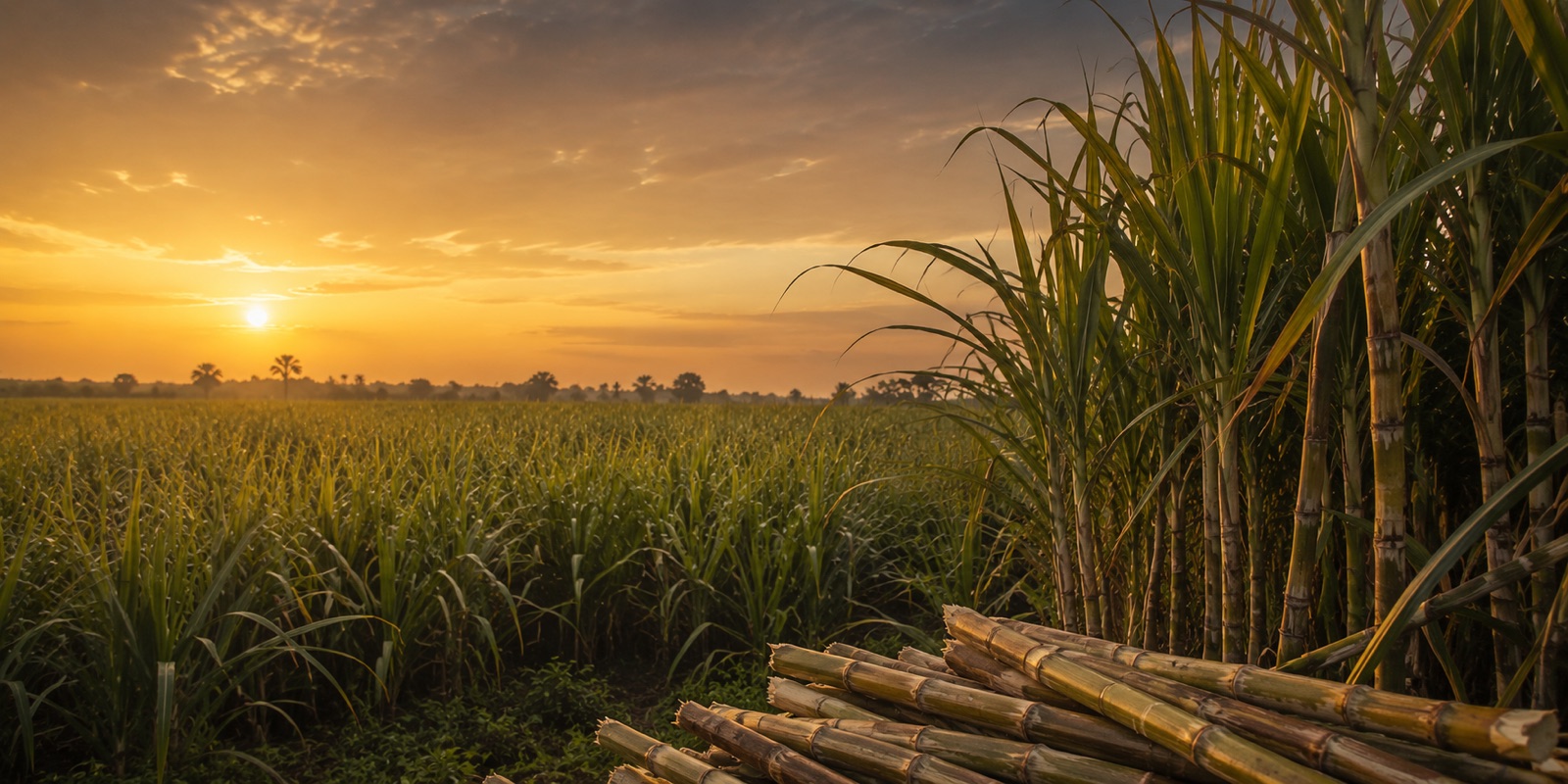
Sugarcane harvest
India crushes ~370 million tonnes of sugarcane a year — the world's second-largest harvest after Brazil. Most of it goes to sugar mills concentrated in UP, Maharashtra, Karnataka and Gujarat.
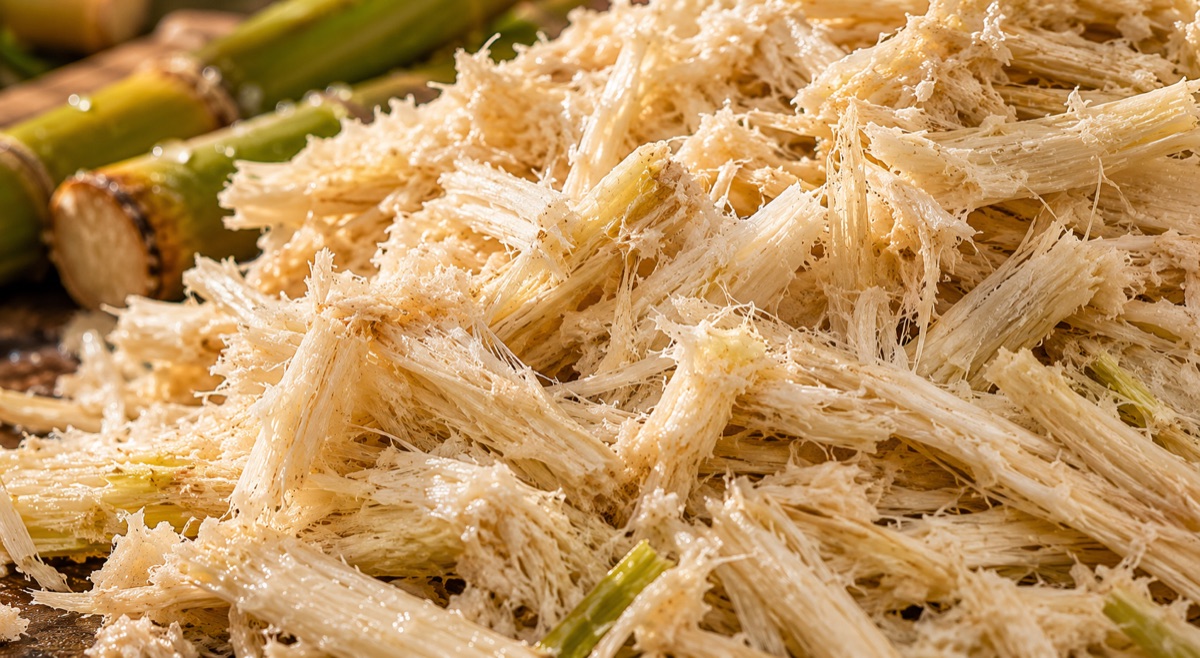
Juice extraction
At the mill, cane is crushed between heavy rollers to squeeze out the juice. Every tonne of crushed cane yields ~280–300 kg of a fibrous, wet residue — that residue is bagasse.
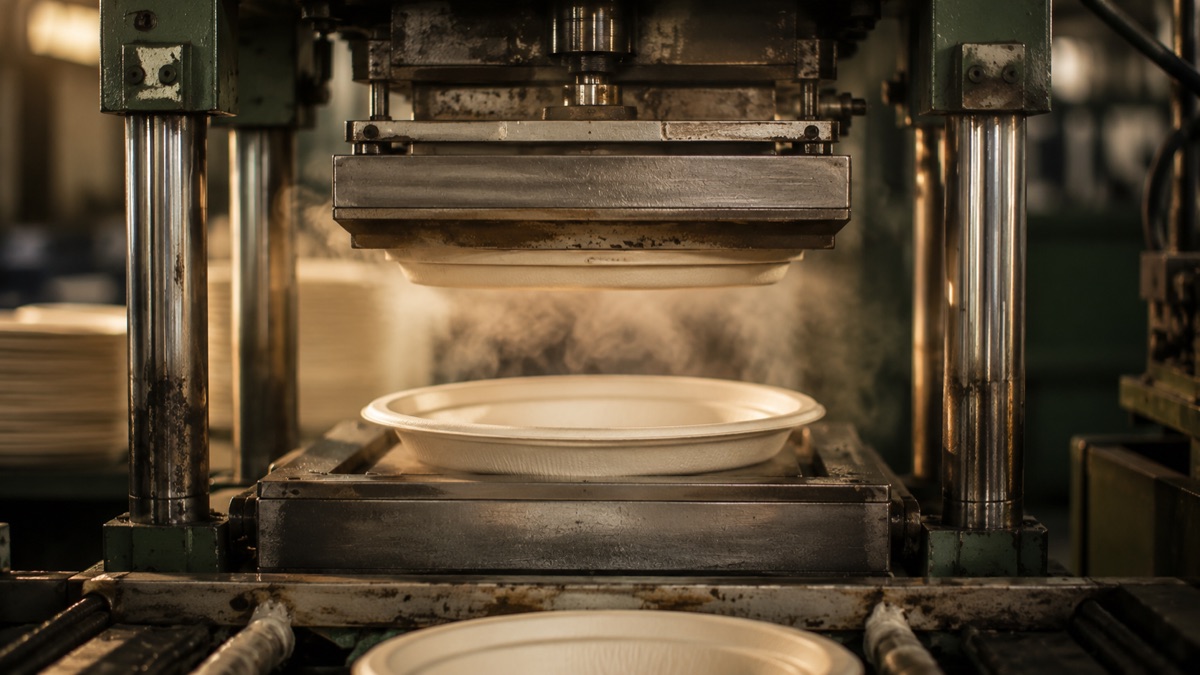
Pulping & moulding
The bagasse is pulped with water (no plastic lining; PFAS-free per our manufacturers' test reports), then pressure-moulded between heated metal dies into plates, bowls, trays and containers. The water is recycled in a closed loop.
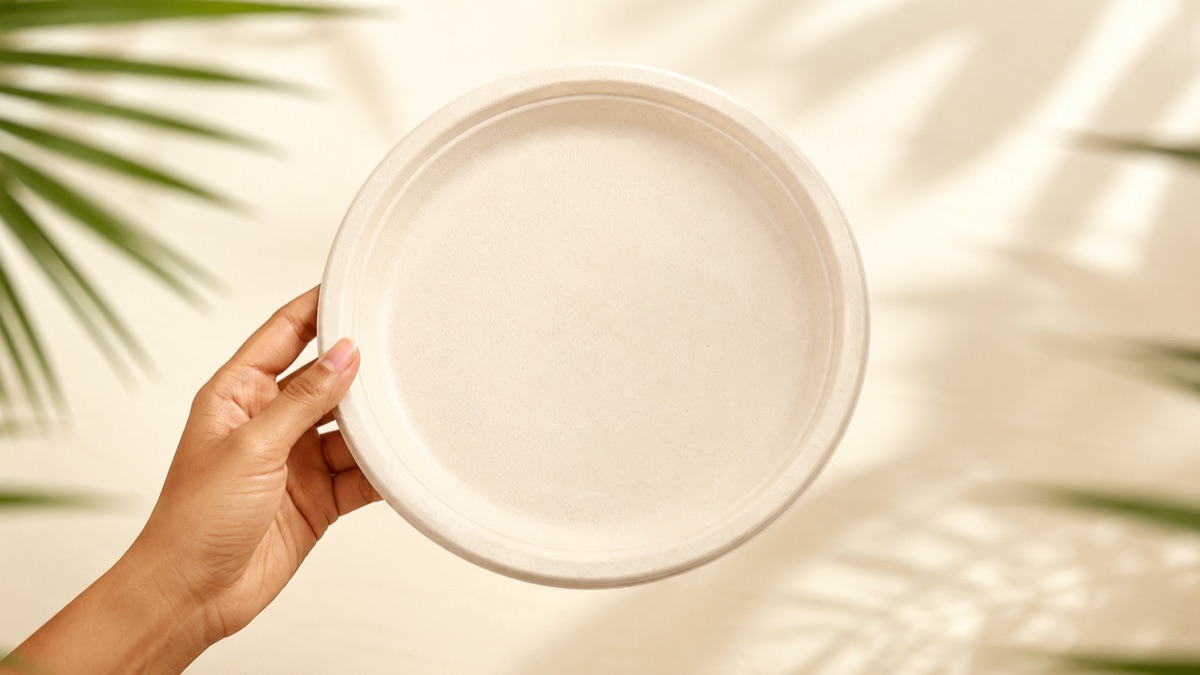
Plate-to-soil
After one meal, the plate goes into a home compost bin — or the municipal organic-waste stream. In commercial composting it typically breaks down in about 90 days; home composting takes longer. No plastic lining to leave microplastic behind.
Why we built PulpyWare
India has a plastic-plate problem. Bagasse is the answer that scales.
India bans single-use plastic cutlery and plates under the 1 July 2022 Single-Use Plastic notification — and the ban is real, but the alternatives in the market are mostly worse than the disease. Coated paper plates with PFAS linings. PLA cornstarch "compostables" that only break down in industrial composters that barely exist in India. Areca-leaf plates that look beautiful for a wedding but can't scale past a few hundred units per supplier.
Bagasse is the one fibre that solves all three problems at once: it's plain plant fibre that composts, it's PFAS-free per our manufacturers' test reports, and it scales — Indian sugar mills produce more bagasse than the entire packaging industry needs.
We built PulpyWare for two buyers on the same platform: the household ordering 100 plates for a Diwali pooja, and the cloud kitchen reordering 5,000 burger boxes a month. Same plate. Same quality. Different price tier. The household pays D2C list. The verified HORECA buyer pays 20% less and gets NET-15 invoice terms.
We deliberately stayed domestic. International B2B export is a different business — it lives at our sister property bagassefoodpackaging.com. PulpyWare exists for India. All tableware ships under HSN 4823 at 18% GST, with input-tax-credit invoices issued in your GSTIN.
Our suppliers
Made in India by established manufacturing partners.
PulpyWare tableware is made by manufacturing partners across India. We source from manufacturers that hold the food-safety and compostability certifications described on this page — ISO 22000, FDA food-contact compliance, BPI and EN 13432 — though the exact certifications vary by manufacturer and product line. Every product in our catalogue records the manufacturer item it comes from, so any question about a product can be taken back to its manufacturer.
An ISO 22000 food-safety management system covers hazard analysis, raw-material traceability and recall procedures at the manufacturer's factory. Ask us for the manufacturer's certificate behind any product you're buying.
We don't name individual manufacturers publicly for commercial reasons, but we can share a product's manufacturer certificate on request.
The composting reality
"Compostable" — what that actually means.
A bagasse plate is short cellulose fibre held together by water and pressure, so soil microbes can break it down. In commercial composting — heat, moisture and regular turning — it typically breaks down in about 90 days, per our manufacturers' data. In a home compost bin with a balanced mix of greens (food scraps, garden cuttings) and browns (dry leaves, cardboard), kept moist and turned regularly, it takes longer.
Three honest qualifiers we put on this claim:
- Home compost, not landfill. A plate buried in an oxygen-starved landfill breaks down much more slowly — that's true for every compostable on earth, and it's a reason to segregate organic waste, not to skip bagasse.
- Temperature matters. Indian winter compost (Delhi NCR, January) runs slower than summer compost (Chennai, May), so home-composting time varies a lot.
- Greasy plates compost too. Oil and food residue are themselves compost fuel. Wipe off heavy sauce; the rest is fine. Skip the rinse — it's just water down the drain.
Our manufacturing partners hold BPI and EN 13432 compostability certification (these vary by manufacturer and product line) — ask us for the certificate behind a specific product. More on the sustainability page.
Certifications
Our manufacturing partners' certifications.
These are held by our manufacturing partners, not by PulpyWare, and vary by manufacturer and product line. Ask us for the certificate behind a specific product.
FDA food-contact (21 CFR §176.170)
US FDA food-contact compliance, held by our manufacturing partners.
BPI
Biodegradable Products Institute compostability certification (commercial composting), held by our manufacturing partners.
EN 13432
The European standard for industrially compostable packaging, held by our manufacturing partners.
ISO 22000
Food-safety management certification at our manufacturing partners' factories.
PFAS-free
PFAS-free (per- and polyfluoroalkyl substances) per our manufacturers' test reports.
Anti-greenwashing pledge
We will never call ourselves "eco-friendly" without a specific number.
The compostable-disposables category is full of vague claims. Here are the rules we hold ourselves to, in writing, on this page, so you can call us on them.
-
No vague adjectives without a number.
"Eco-friendly", "green", "natural" never appear alone. They appear beside a specific claim — "compostable (typically about 90 days in commercial composting)", "PFAS-free per our manufacturers' test reports".
-
No comparison without an axis.
"Better than the regular plate" is meaningless. We always name the comparator — "vs virgin-pulp paper", "vs PLA cornstarch", "vs areca leaf at scale" — and the metric we're comparing on.
-
Every percentage has a footnote.
Figures on this site come from published sources or our manufacturers' data, and we say which. If we can't cite it, we don't print it.
-
"Compostable" always carries the condition.
We say "compostable — typically about 90 days in commercial composting, longer at home" — never "fully compostable" with no qualifier. "Biodegradable" alone is never used.
-
Certifications are our manufacturers'.
Certifications named on this site are held by our manufacturing partners, not by PulpyWare, and vary by manufacturer and product line. Ask us for the certificate behind any product.
-
Cutlery is paper, not bagasse — and we say so.
Our paper cutlery line uses food-grade paper, not bagasse. The PDP voice surfaces the distinction in the first paragraph, not buried in a spec table. No one should buy "bagasse cutlery" by accident.
Try a starter carton — or apply for HORECA pricing.
The fastest way to evaluate bagasse is to put one in your kitchen. Shop the full catalogue at D2C list, or apply for verified HORECA tiering — typical savings 20% off D2C with NET-15 invoice terms.