Festival & Religious Catering
For the langar line, the pandal, the iftar, the Onam sadhya.
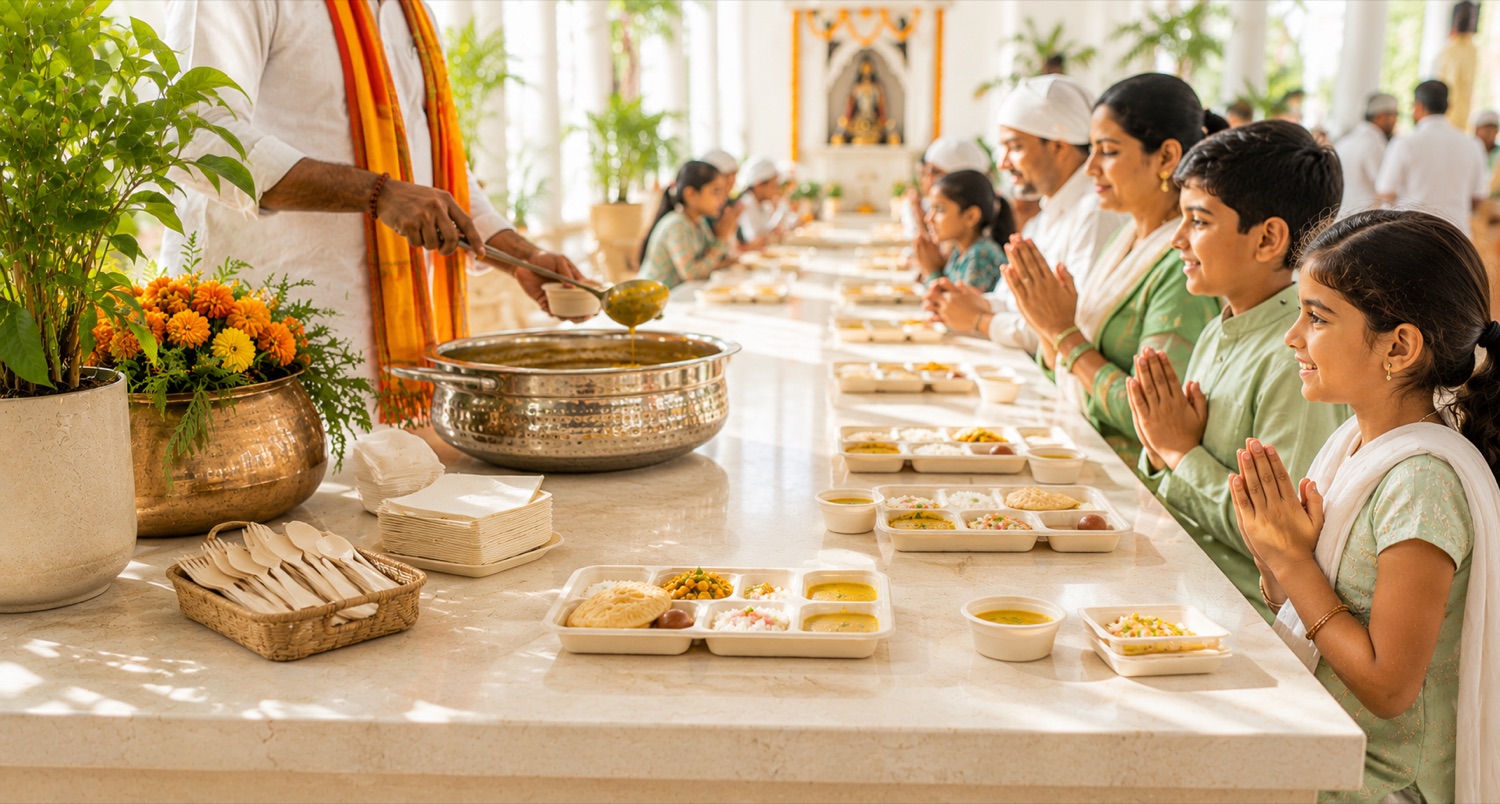
Bagasse thali trays for temple langar, 4-inch dona bowls for festival prasad, compartment plates for community sadhya — single-material plant-fibre tableware that fits the cultural format AND the no-wash-up logistics of large-scale community feasts. No plastic in the feed cycle. Plate-to-soil in 60-90 days.
Why bagasse fits the festival / community model.
Community feast logistics are unforgiving: cook for hundreds or thousands, serve over a 2-4 hour window, hand out food and walk away. Steel thalis are the traditional gold standard but the wash-up is brutal — most temples and event organisers can't run a steel cycle past about 300 guests without ad-hoc help. Plastic and PE-coated paper solve the wash-up problem but introduce a non-compostable disposal stream that doesn't fit the spirit of the event.
Bagasse is single-material plant fibre — sugarcane, agri-waste, naturally vegan, no animal-derived inputs, no synthetic coatings. It mirrors the cultural form factors (the 9-compartment thali, the 4-inch dona for prasad and chaat) while solving the no-wash-up constraint. After the event, plates compost (typically about 90 days in commercial composting) at home, or in days at a commercial organics composter. Many of our accounts are temples and religious organisations that compost on the temple grounds themselves.
The 8 SKUs for festival + religious catering
Covers temple langar, pandal prasad distribution, community sadhya, iftar service, and festival meal programs. Mix and match per event scale.
- 1
9-compartment thali tray
The canonical thali — sabzi, dal, rice, roti, raita, sweet, pickle
- 2
4-inch dona bowl
Prasad, chaat, festival snacks — cultural format
- 3
3-comp round 9-inch plate
Simplified thali — dry sides + 2 curries
- 4
9-inch round plate
Standard meal plate for community feasts
- 5
8 oz tumbler
Water service — single-use, no wash-up logistics
- 6
Paper cutlery set
Spoon + fork for non-traditional service
- 7
2 oz dip cup
Chutney, pickle, raita — separate from main plate
- 8
8 oz round bowl
Kheer, payasam, sweet pongal, festival desserts
Festival-by-festival breakdown
How Indian community feasts and religious events typically use bagasse, by occasion.
Diwali
Festival meals, community lunches, neighborhood get-togethers, corporate Diwali parties.
Onam
Onam sadhya served traditionally on banana leaves — 9-compartment thali is the closest disposable form factor. Some accounts run thali + paper banana leaf liners together.
Eid
Iftar gatherings, community Eid lunches, mosque-organised feast service for the wider neighborhood.
Pongal & Sankranti
Community pongal cooking + serving, especially South Indian temple distributions and rural village feasts.
Ganesh Chaturthi
Pandal-side prasad distribution, modak and kheer service, 10-day community meal programs.
Temple langar (year-round)
Gurudwara langar, ISKCON prasad distribution, weekly temple feeding programs — high-volume community service.
For religious + community organisations
Same HORECA pricing — apply with your trust / society GSTIN
Temples, religious societies, and community organisations registered under Section 12A / 80G of the Income Tax Act qualify for HORECA pricing on production of GSTIN. Same flat ~20% off list, free shipping on every order, NET-15 invoicing after first clean cycle.
Apply for HORECA pricing →Festival + religious catering — frequently asked questions
How does bagasse fit Indian temple langar / community feast service?
Temple langar logistics are typically: cook for 500-5,000+ people, serve over 2-4 hours, no wash-up infrastructure. Bagasse is purpose-built for that — single-use, no wash, compostable (typically about 90 days in commercial composting). The 9-compartment thali tray mirrors the structure of a traditional steel langar thali. The 8 oz tumbler handles water service. After the meal, plates go into a single bagged organics stream that can be composted on-site at the temple grounds or sent to a municipal organics processor.
Can guests at a wedding or festival event compost the plate at home?
Yes — that's actually one of the biggest brand stories for hosts. Every PulpyWare plate is compostable (our manufacturing partners hold BPI certification) (typically about 90 days in commercial composting). Guests who take a plate home can drop it straight into a home compost bin or municipal organics. We can supply a one-page printed insert with composting instructions for events that want to make this explicit to guests.
What's the typical reorder cycle for community / religious organisations?
Most temple langar accounts run a quarterly cadence — bulk delivery once every 3 months covering ~12 weekly services. Festival-specific accounts (Diwali, Onam, Eid) typically order in 4-6 week windows around the festival. Approved HORECA accounts get free shipping on every order regardless of cart size, which makes the cadence math much simpler — order what you need, not what hits a free-shipping threshold.
Are the dimensions of your 9-compartment thali tray suitable for traditional sadhya / langar serving?
Yes — the 9-compartment round tray is sized at 11-inch (280 mm) diameter, 42 g pulp weight, with bays sized to handle the canonical sabzi + dal + rice + roti + raita + sweet + pickle layout. For Onam sadhya specifically, the 4-inch dona bowls work well for the multiple side dishes (avial, thoran, olan, mango pickle) that traditional sadhya places to the right of the main banana leaf.
How do we organize composting for a large festival event with thousands of plates?
Three approaches we've seen work: (1) On-site composting bin for the festival period, then transferred to a municipal organics processor — works for temples and large pandals. (2) Tie-up with a local urban composter / waste management partner who picks up after the event — typically ₹2-5 per kg of organics, much cheaper than landfill. (3) Send guests home with the plate + a one-pager on home composting — works for smaller events where guests are individual households. We can help connect organisers with local composters in the major metros.
Are bagasse plates accepted by traditional / religious authorities?
Bagasse is plant-derived (sugarcane fibre), naturally vegan, no animal-derived inputs at any stage, no animal testing. It's been accepted by ISKCON for prasad service, by gurudwaras for langar service, by major mosques for iftar distribution, and by community temple kitchens across South India. The single-material plant-fibre composition fits more religious / cultural acceptability frames than PE-coated paper or plastic alternatives.
Related use cases & collections
- 100% Bagasse
- No Plastic Lining
- Microwave-Safe
- Made in India
- Manufacturer certifications:
- FDA food-contact
- BPI
- PFAS-free