Every claim and what it rests on. In one place.
This page lists the claims we make elsewhere on the site and what each one rests on — our manufacturing partners' certifications and test reports, their product specifications, or a public source. Certifications are held by our manufacturing partners, not by PulpyWare, and vary by manufacturer and product line.
The plastic problem in Indian food service
India tossed ~120 billion disposable plastic plates before the 2022 ban. The replacements matter.
India's Plastic Waste Management (Amendment) Rules 2021 banned single-use plastic plates, cups, cutlery, and 19 other items effective 1 July 2022. Pre-ban industry estimates put domestic disposable plastic-plate consumption at roughly 120 billion units a year — most of it from cloud kitchens, catering, weddings, and street vendors who had no economic alternative.
The Central Pollution Control Board reports India generates ~3.4 million tonnes of plastic waste annually, of which a sizeable fraction is single-use food packaging. Only about 60% is collected for recycling; the remainder is landfilled, open-burned, or escapes into water bodies. Plastic from food service is one of the categories where the gap between "banned" and "actually substituted" is widest — because the cheapest replacement has been PE-coated paper, which is not actually compostable.
Bagasse exists in the gap. It's a domestic feedstock (no import dependence), it composts in home conditions, and Indian sugar mills already produce more bagasse fibre than the entire domestic food-packaging industry could absorb.
The honest comparison
Bagasse vs paper vs PLA vs areca leaf.
Six axes that actually matter to a procurement decision — not the PR ones. Areca leaf wins on aesthetics; PLA is a near-miss for industrial compost; bagasse wins on compostability and scale.
| Axis | Bagasse | Paper (virgin pulp) | PLA cornstarch | Areca leaf |
|---|---|---|---|---|
| Source material | Sugarcane residue (waste stream) | Virgin tree pulp | Cornstarch (food crop) | Areca palm leaves (gathered) |
| Compostable | Yes — ~90 days commercially, longer at home | Yes, if uncoated — but many are coated or lined | No — industrial only (60 °C+) | Yes |
| PFAS / coating | PFAS-free per manufacturer test reports | Sometimes PFAS-treated for oil/water | None, but PLA itself is the issue | None — natural leaf |
| Microwave / hot food | Yes — 3 min @ 700–1000 W | Variable — PE-lined fails | No — deforms above 60 °C | Yes |
| Cost vs plastic | +30–60% at retail | +20–40% | +40–80% | +60–100% (and patchy) |
| Scale in India | High — sugar industry surplus | High but tree-felling cost | Low — most PLA imported | Low — cottage-scale only |
Claim inventory
13 claims. 13 substantiations.
Every claim that appears in product copy is listed here with the evidence behind it. If you see a claim on the site that isn't on this list, mail us at hello@pulpyware.in and we'll remove it or add it.
| Claim | Substantiation |
|---|---|
| 100% sugarcane bagasse fibre | Manufacturer specification. |
| Compostable | Typically about 90 days in commercial composting (manufacturer data); home composting takes longer. Our manufacturing partners hold BPI and EN 13432 compostability certification. |
| Made from sugarcane waste | Bagasse is the fibrous residue left after sugarcane juice extraction. |
| PFAS-free | Per our manufacturers' test reports. |
| FDA food-contact compliance | Held by our manufacturing partners (21 CFR §176.170). |
| BPI | Compostability certification held by our manufacturing partners. |
| EN 13432 | European compostable-packaging standard, held by our manufacturing partners. |
| ISO 22000 | Food-safety management certification at our manufacturing partners' factories. |
| Microwave safe (up to 3 min @ 700–1000 W) | Manufacturer specification. |
| Oil & water resistant | Manufacturer specification. |
| Made in India | Made in India by our manufacturing partners. |
| Vegan | Plant fibre — no animal-derived materials. |
Impact counter methodology
The math behind every "trees saved" number on the site.
The homepage and per-order pages will eventually show a live impact-counter (planned for Phase 1.5). The coefficients below are the ones we use, computed transparently from public sources.
Per 9-inch plate (~13 g)
- · ~0.0002 trees saved vs virgin-pulp paper equivalent
- · ~1.2 litres of water saved (manufacturing)
- · ~5 g CO₂e avoided vs virgin-pulp paper
- · ~5 g plastic kept out of landfill vs PE plate
- · ~0.013 kg CO₂e avoided vs plastic plate (lifecycle)
Where the numbers come from
- · 1 tonne virgin-pulp paper ≈ 17 trees + ~90,000 L water (FAO)
- · 1 tonne bagasse pulp ≈ 0 trees + ~30% less water (industry LCA)
- · Typical plastic plate weight ≈ 5 g (industry catalogue average)
- · CO₂e factors: Defra 2024 + IPCC AR6 GWP100 values
Per-SKU coefficients (trees_saved_per_unit,
water_litres_saved_per_unit,
co2_kg_avoided_per_unit,
plastic_grams_displaced_per_unit)
live in product metadata. Counter sums across completed orders,
recomputed nightly and cached. Source data is available on request.
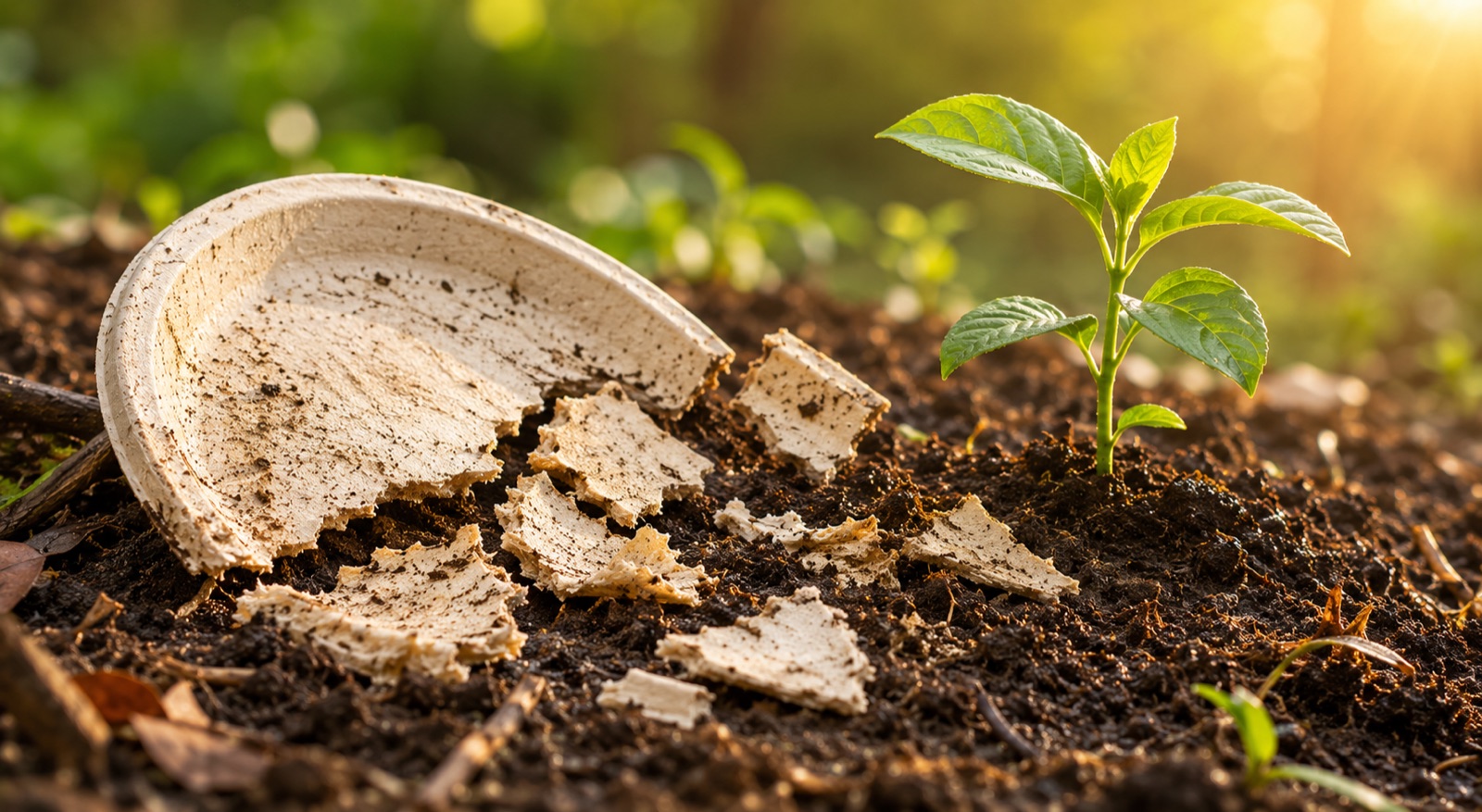
The composting reality
What composting a bagasse plate actually involves.
First weeks
The plate softens, absorbs moisture, and breaks at any pressure point. Fibre structure remains identifiable.
Following weeks
Fibre disintegrates into soft brown mass; bacteria and fungi do the structural breakdown. Stir/turn the bin regularly for airflow.
End state
End-state compost: soft, earth-smelling soil amendment. Indistinguishable from kitchen-scrap compost. Apply to your balcony pots, garden beds, or municipal organic stream.
A small honest disclaimer
Timing varies: in commercial composting a bagasse plate typically breaks down in about 90 days (manufacturer data); a home bin takes longer and depends on moisture, heat and turning. In an oxygen-starved landfill, a bagasse plate breaks down much more slowly — that's true for every compostable on earth. The compostability claim is not an excuse to put it in the general waste bin. Segregate organic waste at source; compost at home or via the municipal organic stream.
Manufacturer certificates
Need a certificate for your compliance file?
The certifications named on this site — FDA food-contact compliance, BPI, EN 13432, ISO 22000 — and the PFAS test reports are held by our manufacturing partners, not by PulpyWare, and vary by manufacturer and product line. Tell us the products you're buying and we'll ask the manufacturer for the relevant certificate or test report.
Email sales@pulpyware.in with the SKUs (and your GSTIN for business orders).
Read the story behind the numbers.
The narrative — why we exist, who manufactures for us, and the rules we follow for environmental claims — lives on the Bagasse Story page.