PFAS-Free Eco Tableware: Why It Matters for India
PFAS — 'forever chemicals' — coat many 'compostable' paper plates. Here's what they are, why they're being banned globally, and why PulpyWare sources from manufacturers whose test reports show PFAS-free products.
If you buy a "compostable" paper plate in India, there's a real chance it's coated with PFAS — per- and polyfluoroalkyl substances, also called "forever chemicals". The coating is what makes the plate oil- and water-resistant. It also doesn't biodegrade, accumulates in soil and groundwater, and has been linked to a long list of health issues.
California banned PFAS in food packaging in 2023. France banned it from 2024. The EU is phasing it out by 2026. India has no current ban, which means some "compostable" food packaging sold in the Indian market may still contain it — and the compostability claim is only half-true. The plate disintegrates; the chemicals stay.
This post explains what PFAS is, why it matters even for ordinary household use, and why PulpyWare's products are PFAS-free per our manufacturers' test reports.
What PFAS actually is
PFAS is a family of ~12,000 synthetic chemicals built around carbon-fluorine bonds — one of the strongest single bonds in chemistry. The strength of the bond is what gives PFAS its useful properties: it repels oil, water, and grease at room temperature, doesn't degrade in heat, and forms thin, invisible films. The same bond is what makes it impossible to break down naturally.
Common consumer products that contain PFAS:
- Non-stick cookware (Teflon, the canonical PFAS — being phased out by most manufacturers since 2015)
- Waterproof clothing (Gore-Tex's original formulation, now reformulated)
- Stain-resistant carpet and upholstery
- Microwave popcorn bags (until ~2020)
- Fast-food wrappers and cardboard burger boxes
- "Compostable" paper plates and bowls coated for oil resistance
In food packaging, PFAS is used because uncoated paper goes soggy with oil or sauce. The coating is a 10-50 micron film, often invisible to the eye. Suppliers can legitimately claim "compostable" because the paper itself decomposes, but the PFAS doesn't go anywhere — it leaches into soil during composting, into food during use, and into groundwater forever after.
The health and environmental case
PFAS accumulates in human tissue. Once ingested, it doesn't break down — the half-life of common PFAS compounds in human blood is 2 to 5 years[^1]. Over a lifetime of daily exposure (food packaging being one major route), levels build up.
Documented health effects of high PFAS exposure include:
- Liver damage and elevated cholesterol
- Thyroid disease
- Reduced immune response (notably reduced vaccine effectiveness in children)
- Decreased fertility, lower birth weight in pregnant women
- Increased risk of testicular and kidney cancers (IARC classified PFOA as "possibly carcinogenic to humans" in 2017, upgraded to "carcinogenic" for some compounds in 2023)[^2]
Environmentally, PFAS in compost goes into the soil; in soil, it goes into the groundwater; in groundwater, it goes into drinking-water supply. PFAS is now detectable in human blood worldwide and in rainwater on every continent including Antarctica[^3]. The "forever chemical" name is not marketing — it's a statement about a molecule that doesn't degrade.
Why this matters for Indian compostable buyers
India's 1 July 2022 single-use plastic ban created a sudden market for paper and bagasse disposables. Many suppliers rushed in with PFAS-coated paper plates because it's cheaper than reformulating with a PFAS-free coating, and because Indian regulations don't yet require disclosure. A "compostable paper plate" at ₹0.80/piece is almost certainly PFAS-coated; the alternative coatings (silicone, plant-based wax) cost more.
The result: a buyer who thinks they've upgraded from plastic to "compostable" has actually traded a known harm (plastic in landfill) for an invisible one (PFAS in their food, their compost, their groundwater). The compostability claim is technically true and substantively misleading.
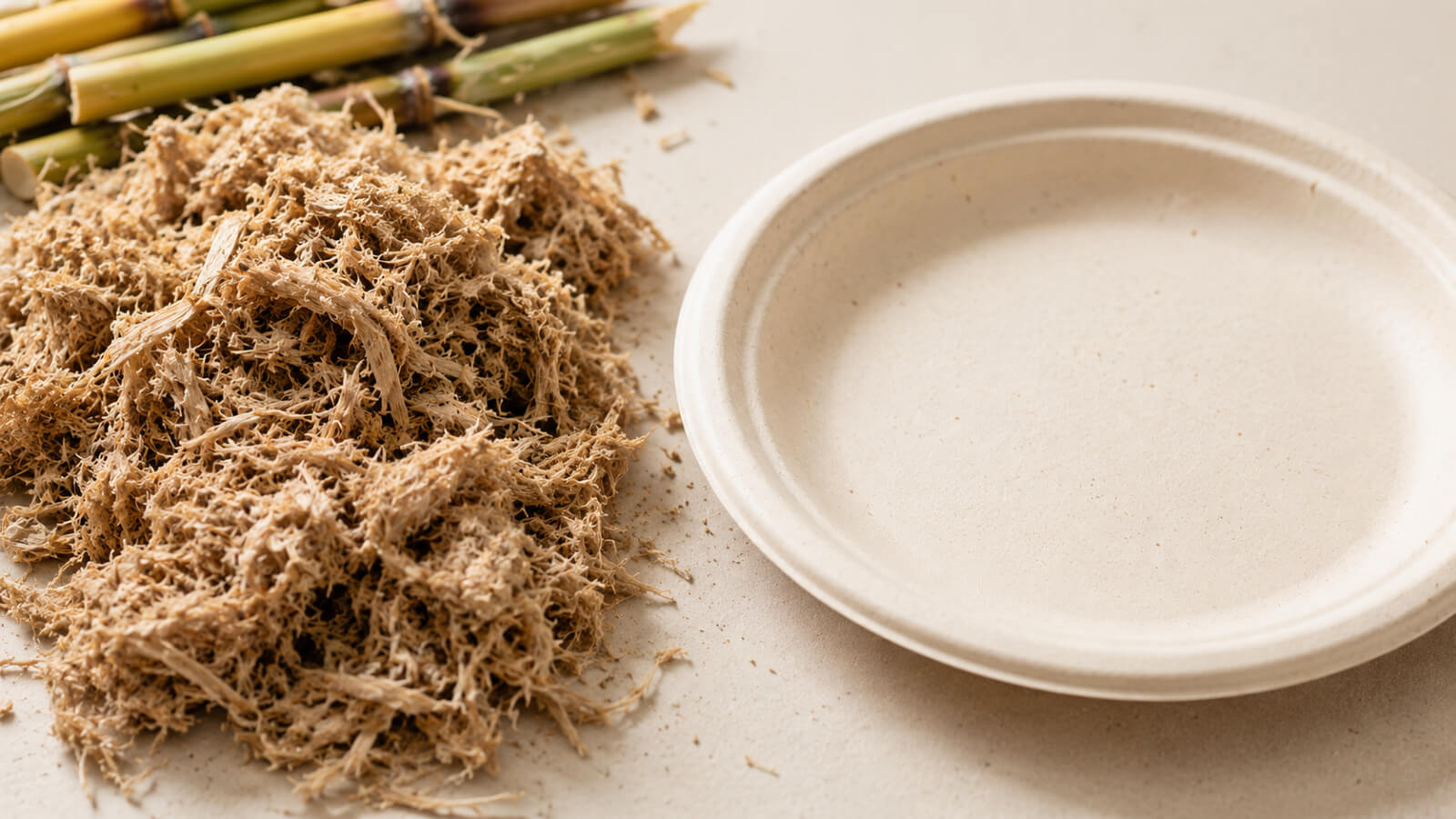
This is the gap PulpyWare was built to fill. Bagasse, by structure, doesn't need a coating — the fibre is naturally water-resistant for the duration of a meal because of its density and lignin content. Our manufacturers' test reports show their bagasse products are PFAS-free.
What to ask a supplier
If a vendor pitches you "compostable" food packaging, ask for two specific things in writing:
- A PFAS-free lab test certificate — independent lab, recent (within 12 months), tests for total fluorine content and specific PFAS compounds. Eurofins, SGS and BIS-accredited labs all do these tests. The certificate should name a specific lab and date.
- A compostability certification — BPI (American) or EN 13432 (European). Marketing words like "biodegradable" or "eco-friendly" without one of these is unsubstantiated.
For PulpyWare products, these are held by our manufacturing partners — ask us and we'll request the manufacturer's documents for the products you're buying (more on the sustainability page). If a supplier can't produce these documents on request, the absence is the answer.
What about wax-coated paper?
Some paper plates are coated with carnauba wax or beeswax instead of PFAS — these are plant or animal derived and genuinely biodegradable. They're a valid alternative, though the coating wears off faster than PFAS (so longer-hold use cases like overnight delivery don't work as well), and they don't repel oil as effectively. For most Indian use-cases bagasse outperforms wax-coated paper on durability while remaining fully compostable.
Areca leaf plates are another genuinely PFAS-free alternative — see the buyer's guide post for where they fit.
The regulatory direction
PFAS regulation is hardening worldwide. India's current absence of a food-packaging PFAS ban is a regulatory lag, not a permanent state — once detection becomes routine in domestic testing labs and a few high-profile cases land, the ban is likely. PulpyWare's position is to be PFAS-free now, when it's an active choice, rather than after a regulator requires it.
Choose compostable disposables backed by a PFAS test report. The bagasse plate that goes into your home compost shouldn't leave a chemical residue in the soil your tulsi grows in.
For the compostable-disposables landscape, see the complete guide. For bagasse vs the alternatives, see bagasse vs paper vs PLA vs areca.
[^1]: Olsen et al., "Half-Life of Serum Elimination of PFOS, PFHxS, and PFOA in Retired Fluorochemical Production Workers," Environmental Health Perspectives, 2007. [^2]: International Agency for Research on Cancer (IARC) — PFOA classification, 2023. [^3]: Cousins et al., "Outside the Safe Operating Space of a New Planetary Boundary for PFAS," Environmental Science & Technology, 2022.
Ready to buy?
Browse our full product catalogue or request wholesale pricing.