The Complete Guide to Compostable Tableware in India
Bagasse, paper, PLA, areca leaf, wood — what each material actually is, how it composts, where it makes sense, and what to avoid. A no-marketing buyer's guide.
"Compostable" is one of the most over-used words in Indian sustainability marketing. Every disposable plate at a wedding catering stall now claims to be compostable. Some are; many are not. Some need a home compost bin; some need an industrial composter that doesn't exist within 50 km of your kitchen.
This guide is the boring version: what each material actually is, where it composts, the cost band you should expect, and the honest "where it shines / where it doesn't" call. No brand pitches.
The five materials you'll encounter
In an Indian context, the genuinely compostable disposable tableware materials are:
- Bagasse (sugarcane residue moulded into plates / bowls / containers)
- Food-grade paper (FSC-certified, no plastic coating, no PFAS)
- PLA (cornstarch bioplastic)
- Areca leaf (palm leaves pressed into plates)
- Wood / bamboo (cutlery, skewers)
There's a sixth category — PE-coated paper — which is what most "white paper plates" in the Indian market actually are. It's not compostable; the PE film stays intact. Skip it.
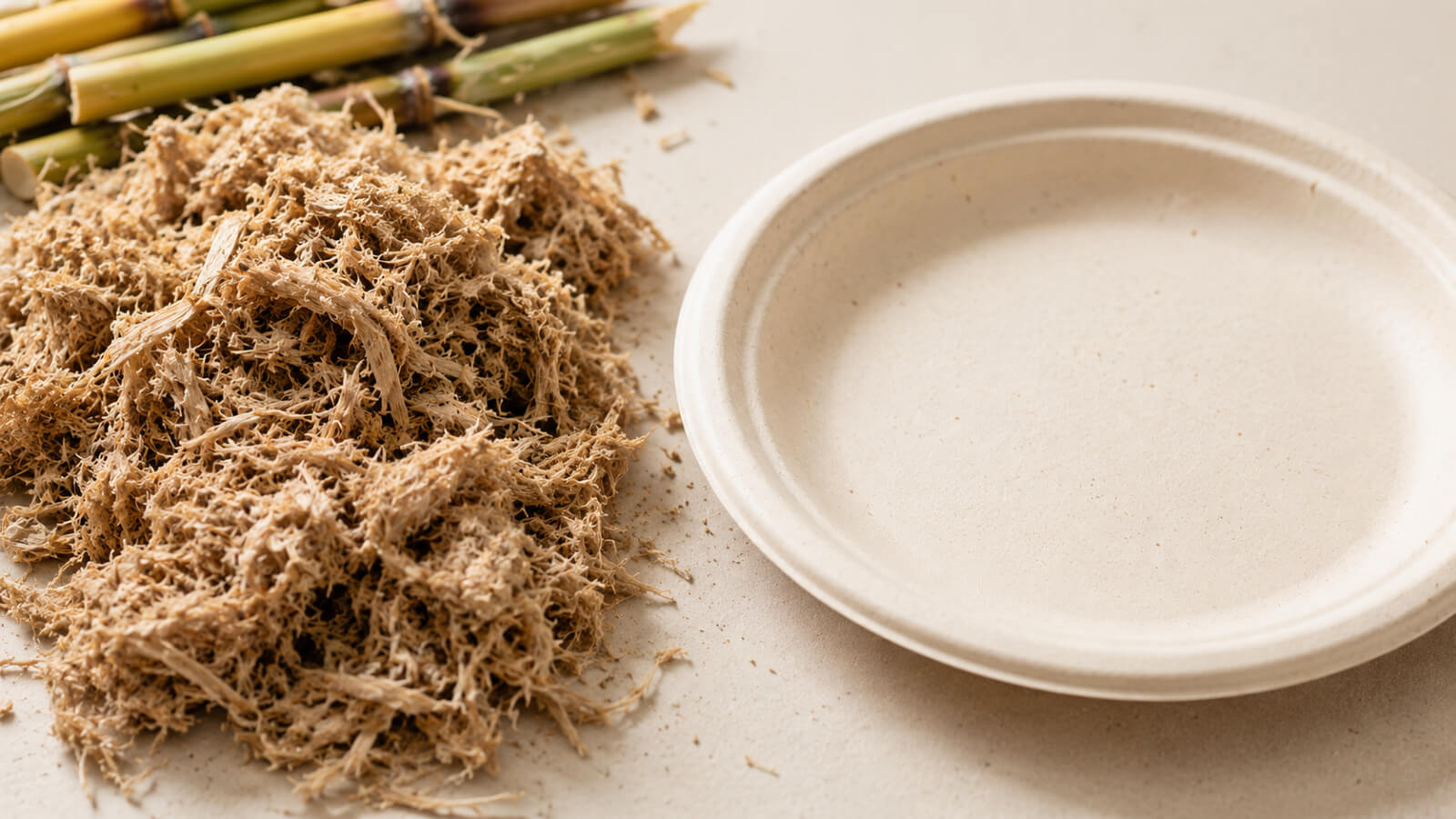
Bagasse
What it is: the fibrous residue left after sugarcane is crushed to extract juice. Pulped with water and pressure-moulded between heated dies into plates, bowls, trays and containers.
Compostability: in commercial composting, typically about 90 days (manufacturer data); a home bin takes longer and varies. Backed by BPI and EN 13432 certifications when sourced from a certified manufacturer.[^1]
Where it shines:
- Plates (round, square, compartment) for daily meals, wedding catering
- Bowls (3 oz dip cups to 32 oz family salad bowls)
- Containers and clamshells for cloud-kitchen delivery
- Meal trays for institutional catering (schools, hospitals, airlines)
Where it doesn't:
- Cutlery — too thin a cross-section to mould rigidly enough; food-grade paper wins here
- Ice cream cups for freezer storage — PE-lined paper holds up better at -18°C
- Very long-hold buffet warming (>90 minutes of hot food sitting)
Cost band: 30–60% premium over banned plastic; ~10% premium over PFAS-coated paper.
Food-grade paper (FSC-certified, no coatings)
What it is: virgin wood-pulp or bamboo-pulp paper at 600–800 GSM, no plastic film, no PFAS coating. Used primarily for cutlery (forks, spoons, knives), cup lids where bagasse can't mould reliably, and napkins.
Compostability: compostable; usually quicker than bagasse because the cross-section is thinner, but timing varies.
Where it shines: cutlery — the only material that gives you knife-edge rigidity without plastic. Small cup lids. Single-use napkins. PulpyWare's Cutlery category is paper, and we disclose it honestly on every PDP because anti-greenwashing means no one should buy "bagasse cutlery" by accident.
Where it doesn't: plates and bowls — paper plates work, but bagasse outperforms on rigidity and microwave behaviour. For plates always pick bagasse.
PLA (polylactic acid, cornstarch bioplastic)
What it is: a bioplastic polymerised from corn or sugarcane starch. Looks and feels like clear plastic; often used for cold cups, lids, and salad bowls.
Compostability: industrial only. PLA needs sustained 60°C+ temperatures with high humidity for 60–90 days to break down — conditions you only get in an industrial composter. In home compost, PLA does almost nothing. In landfill, PLA persists for decades.[^2]
Where it shines: cold cups for juice / smoothie service where you want clear-plastic transparency. Some salad-bowl applications.
Where it doesn't: anywhere in India where you don't have access to an industrial composter — which is almost everywhere. PLA in India is functionally a marketing label, not an actual compostability claim. We don't sell PLA at PulpyWare; treat the claim with skepticism.
Cost band: 40–80% premium over plastic.
Areca leaf
What it is: dried fallen leaves from the areca palm (the same tree that produces the betel nut), washed and pressed into plates and bowls using heat.
Compostability: home-compostable; timing varies. Truly natural — no binder, no chemical processing, just leaves pressed under heat.
Where it shines: weddings and traditional events where a natural-leaf aesthetic is part of the brand. Heavier-weight leaf gives a "premium disposable" feel that bagasse doesn't quite hit.
Where it doesn't: scale. Areca leaf production is cottage-industry — most producers cap out at a few thousand plates a month, and quality varies wildly from supplier to supplier. For a 1,000-guest wedding you can't reliably source from one supplier. For a cloud kitchen with daily reorders, sourcing is unworkable.
Cost band: 60–100% premium over plastic, and patchier supply.
Wood / bamboo
What it is: cutlery, skewers, stirrers in pressed wood (poplar, birch) or bamboo.
Compostability: home compost, 90–180 days (denser cellulose, takes longer than paper or bagasse).
Where it shines: cutlery for premium dining where the "wooden spoon" aesthetic adds to the brand. Cocktail stirrers, picks, skewers.
Where it doesn't: anywhere you're competing on cost. Wood cutlery costs 2–3× paper cutlery for the same function.
The decision tree
Quick algorithm for picking the right material:
- Plates, bowls, containers, trays, clamshells? → Bagasse (PulpyWare's main catalogue)
- Cutlery? → Food-grade paper (our Cutlery category)
- Ice cream cup for freezer storage? → PE-lined paper (we don't sell it; it's not compostable but it's the only material that works)
- Wedding aesthetic, leaf-natural look? → Areca leaf (specialist suppliers; not us)
- Anywhere "PLA cornstarch" is being pitched? → Pause. Ask if there's an industrial composter within 50 km. Usually the answer is no.
What to look for on a certificate
If a supplier claims "compostable", ask for two pieces of evidence:
- BPI (Biodegradable Products Institute) or EN 13432 certificate — these test actual disintegration, biodegradation, and toxicity. Marketing words without these certificates are unsubstantiated.
- PFAS-free lab test — independent lab report showing no per- and polyfluoroalkyl substances. Many "compostable paper" products in India are PFAS-coated to repel oil; the coating doesn't compost.
For PulpyWare products these are held by our manufacturing partners — ask us and we'll request them from the manufacturer (see the sustainability page). If a supplier can't show you their version, the absence is the answer.
What's banned, what's not
Under India's 1 July 2022 single-use plastic ban:[^3]
- Banned: plastic plates, cups, cutlery, straws, ear-buds, balloon sticks, ice-cream sticks, polystyrene packaging
- Not banned: PLA bioplastic (loophole — it counts as "compostable" even though most Indian municipalities can't actually compost it), PE-coated paper (not strictly banned because the visible material is paper)
The ban is real. Cloud kitchens, caterers, and restaurants caught using banned plastic disposables face fines and shutdown notices. The replacement market is still settling, which is why this guide matters.
For specific use-case guidance, see cloud-kitchen packaging checklist, how to host an eco-friendly Indian wedding, or the comparison post.
[^1]: BPI / EN 13432 test methods — disintegration ASTM D6400, biodegradation ISO 14855, ecotoxicity OECD 208. [^2]: Narayan, R. — "Biobased and Biodegradable Polymer Materials," American Chemical Society, 2011. PLA industrial-compost requirements: 60°C+, 60–90 days. [^3]: Ministry of Environment, Forest and Climate Change — Plastic Waste Management (Amendment) Rules, 2021.
Ready to buy?
Browse our full product catalogue or request wholesale pricing.