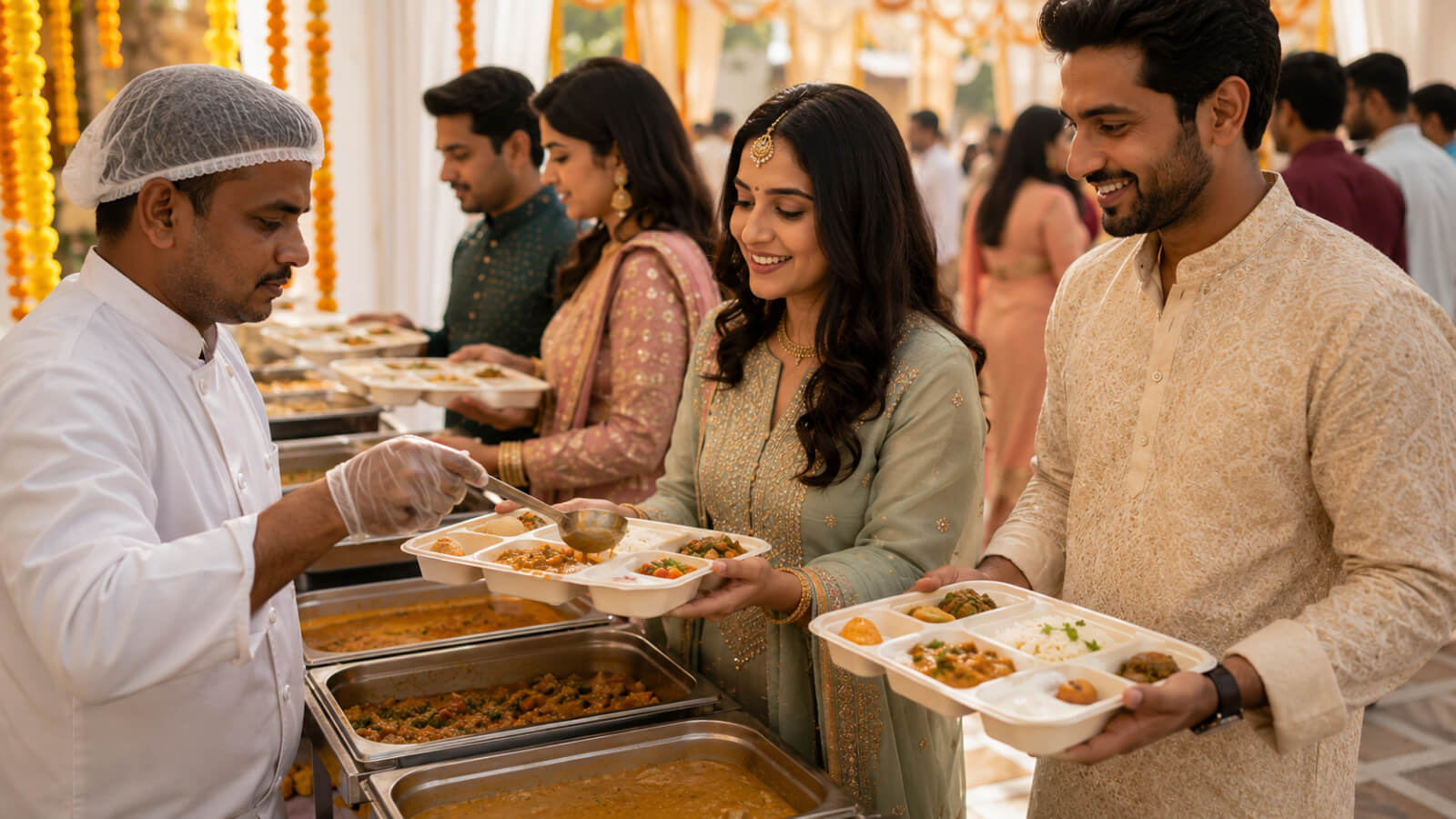
Eco-Friendly Indian Wedding: A Catering Quantity Guide
Plates, bowls, cups, cutlery — how many of each for 100 to 2,000 guests. Plus the menu styles that fit each piece count, and how to plan for breakage.
The Indian wedding-catering format ranges from 100-guest intimate ceremonies to 2,000-guest big-fat-Indian weddings, and the disposable-tableware decision is one of the highest-volume choices a planner makes. Get it wrong and you're either short on plates mid-service, or you've spent the wedding's after-party budget on cardboard.
This post is the quantity-planning guide. We've also embedded a wedding-catering quantity calculator on the use-case page that does the math for you; the rules of thumb below are what feeds the calculator.
The piece-count rules of thumb
Per guest, plan for:
- 1.4–1.6 thali plates or large dinner plates. The 0.4–0.6 over 1.0 accounts for: a guest who comes back for second helpings on a fresh plate, breakage during service, and the ~10% staff-and-extra buffer caterers add.
- 2 small bowls. One for raita, one for dessert/sweet/kheer. Some weddings use 3 (extra for curd-rice or a chutney bowl).
- 3 dip / sauce cups. Chutney, pickle, sweet sauce — at typical Indian wedding menus this is the right count.
- 2 water tumblers. First glass at the start, refill / fresh glass mid-meal. Skip the plastic-bottle service entirely.
- 1.2 cutlery sets. Each set is a spoon + fork. Knife only if your menu has cutting-required dishes. The 0.2 over 1.0 is fork-falls-on-floor breakage.
- 2 napkins. One at the start of the meal, one mid-meal for hand wipe.
So for 300 guests: ~450 thali plates, 600 bowls, 900 dip cups, 600 tumblers, 360 cutlery sets, 600 napkins.
For 1,000 guests: ~1,500 thali plates, 2,000 bowls, 3,000 dip cups, 2,000 tumblers, 1,200 cutlery sets, 2,000 napkins.
Match the format to the menu
Buffet-style with thali plates. The guest takes a thali plate at the start, walks the buffet, sits down to eat. This is the highest-volume Indian wedding format. The 9-compartment round meal tray (PulpyWare's thali collection hero) is the canonical choice — 42 g of bagasse, separate bays for sabzi / dal / rice / roti / raita / sweet / pickle. Pair with paper cutlery and 8 oz tumblers for water.
Sit-down service with separate plates and bowls. A waiter brings each course to a seated guest. This format needs more pieces per guest (3-4 plates total across courses vs 1.4 thali plates) but allows for higher per-course presentation quality. Use the 9-inch round plate for mains, 9-inch deep for biryani / curry course, 6-inch bowl for soup or dal, 5 oz square bowl for raita.
Live-counter / chaat-station format. Multiple stalls (chaat, dosa, paani puri, biryani station) where guests pick small portions across stalls. This format wants smaller plates and lots of donas. Plan for 5-7 small servings per guest. Use 4-inch donas (the dona collection hero), 6 oz bowls, and 6-inch round plates.
Snack + sit-down combo. Pre-dinner snacks at live counters (1-2 hours), then a sit-down dinner. The piece counts add up: ~2-3 donas/bowls per guest for snacks + the full thali-plate count for dinner.
Plan for the wedding season cycle
Indian weddings cluster in two main seasons:
- November to February (peak season — auspicious dates concentrated)
- May to June (secondary peak — summer auspicious dates)
For catering orders in these windows, lead time matters. PulpyWare's standard delivery is 7–10 business days for orders up to ~1,000-guest scale. For peak-season weddings, we recommend ordering 3 weeks ahead to give buffer for last-minute scope changes. HORECA-verified accounts get priority allocation and a dedicated POC for events above 500 guests.
For destination weddings (Udaipur, Jaipur, Goa, Kerala backwaters), add 2 days for the inter-city shipping leg. Pan-India delivery is via Shiprocket — the same logistics layer behind most Indian D2C brands.
The HORECA pricing math
D2C list pricing isn't the right tier for a wedding caterer doing multiple events per month. HORECA-verified accounts (catering companies, event planners, wedding-management firms) get:
- ~20% off D2C list across the catalogue
- NET-15 invoice terms (pay 15 days after delivery)
- Dedicated POC for events above 500 guests
- Priority allocation in peak season
For a 1,000-guest wedding, the gap is meaningful. At ~1,500 thali plates + 2,000 bowls + 1,200 cutlery sets, the 20% HORECA discount typically saves ₹3,000–5,000 per event vs D2C list — enough to upgrade the dessert course or fund the next event's planning.
Apply at /wholesale/; 24-hour admin review.
The cleanup story
The pitch to the family planning the wedding: bagasse means no dishwasher labour. For a 300-guest wedding with steel thalis, you're looking at four hours of post-meal cleanup labour and (in our experience) at least 5-10 broken or "lost" plates per event. With bagasse, the post-meal pile is bagged compostable waste — handed to the municipal organic-waste collector or composted at home if the venue has the infrastructure.
The pitch to the eco-conscious bride or groom: every bagasse plate displaces ~5 g of plastic from landfill. For a 1,000-guest wedding that's ~7.5 kg of plastic kept out of the system, plus ~13 kg of CO₂e avoided vs the equivalent plastic-plate-and-cutlery service. The math is in the sustainability page impact-counter section.
Neither pitch involves greenwashing language. The numbers are specific, the cleanup advantage is real, and the wedding food still tastes the same.
For specific SKU selection see the thali collection and the dona collection. For the use-case page with the embedded quantity calculator, see /use-cases/wedding-catering/.
Ready to buy?
Browse our full product catalogue or request wholesale pricing.