Bagasse vs Plastic: The Real Environmental Math
An honest, source-cited comparison of bagasse and plastic disposables on carbon, water, decomposition, microplastics, and end-of-life. No marketing fluff — just the numbers.
India's 1 July 2022 single-use plastic ban[^1] forced caterers, cloud kitchens, and street vendors to find alternatives. Two years in, the most common replacement isn't actually a replacement: PE-coated paper plates and cups, which look compostable but contain a thin plastic film that doesn't degrade. The honest comparison customers and procurement teams need is bagasse vs unlined plastic — not the marketing version, the real one.
This post lays out the math on six axes: feedstock origin, manufacturing carbon, water use, decomposition, microplastic generation, and end-of-life. Where a number has a citation, I've kept the source inline. Where it doesn't, I've flagged the uncertainty.
Feedstock: where the material comes from
A plastic plate is petroleum. Crude oil is cracked into ethylene, polymerised to polyethylene (PE) or polystyrene (PS), and pressed into shape. Per kg of plastic disposables, the feedstock alone is ~2 kg of CO₂e before manufacturing energy[^2]. There is no carbon sink in this path — the petroleum was sequestered for 100M years; using it releases the carbon irreversibly.
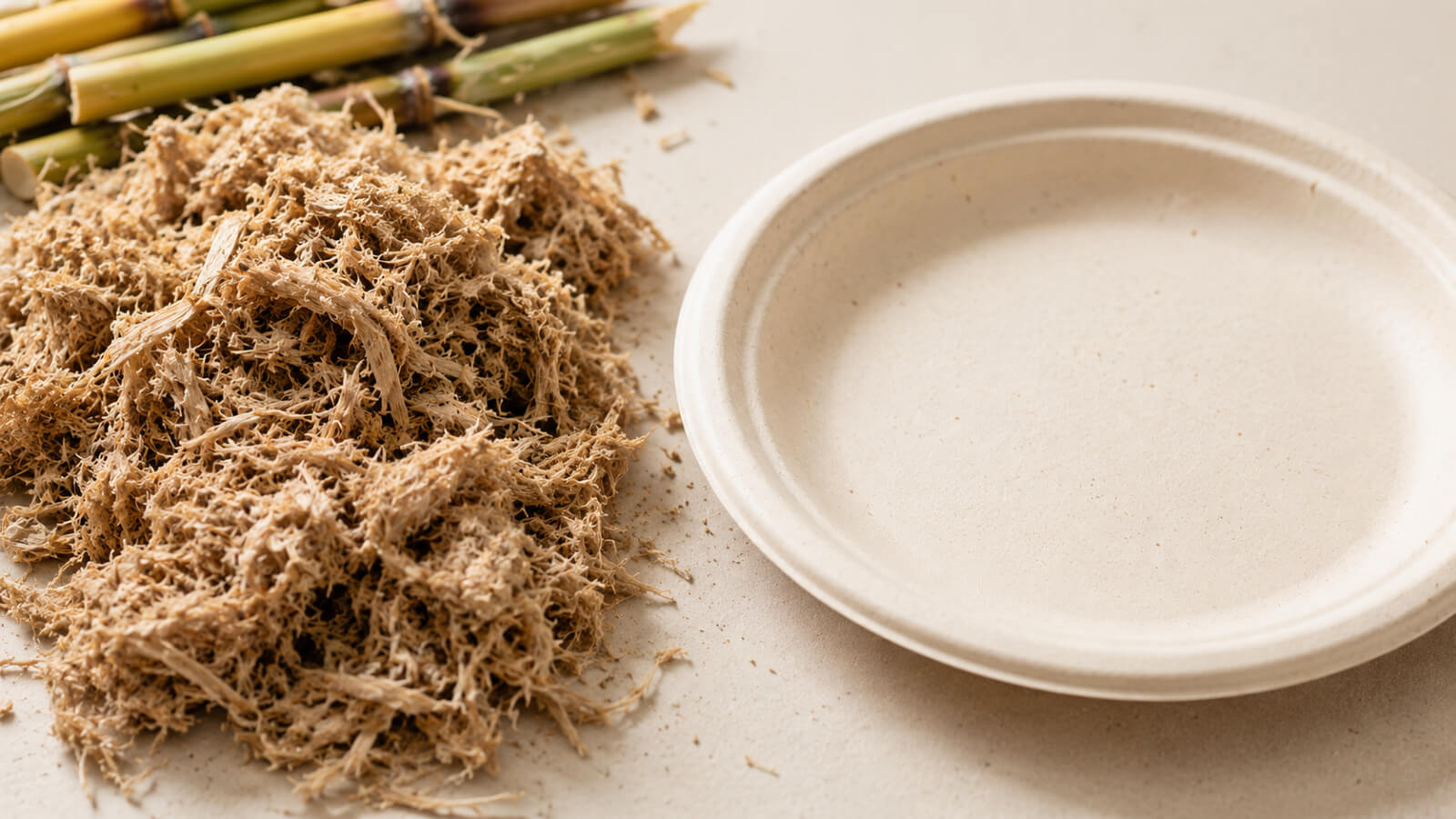
A bagasse plate is sugarcane juice extraction residue. The carbon was photosynthesised from atmospheric CO₂ by the cane plant during a 12-month growth cycle. When the plate composts, the carbon returns to atmosphere as part of a closed annual cycle — net-zero on the feedstock layer. The energy to mould bagasse is comparable to paper-pulp moulding (electricity for pulping + heated dies for pressure-forming), but the feedstock itself is carbon-neutral by virtue of being recently atmospheric.
Bottom line: plastic disposables have a permanent carbon debt; bagasse has none. The number we use on the sustainability page is ~13 g CO₂e avoided per 9-inch bagasse plate vs the equivalent plastic plate.
Decomposition: what happens after one meal
The plastic plate ends up in one of four places:
- Landfill — sealed away from oxygen, breaks down over 100–1,000 years
- Open burning (common in informal Indian waste collection) — releases dioxins and microplastics into the air
- Ocean / waterway — fragments into microplastics, accumulates in fish, returns to humans through diet[^3]
- Recycling — best case, but India recycles only about 60% of collected plastic waste[^4]
The bagasse plate composts. In a home compost bin with greens + browns balance, turned weekly, the plate softens within weeks and breaks down over time — typically about 90 days in commercial composting, longer at home[^5]. In landfill, it breaks down more slowly (anaerobic decomposition is slower for everything), but it doesn't accumulate as microplastic. There is no toxic intermediate.
Microplastic: the hidden externality
Single-use plastic is the largest source of microplastic in the human food chain. A 2019 review estimated that humans ingest the equivalent of one credit card of microplastic per week, much of it from plastic food packaging[^6]. Plastic doesn't break down — it breaks up. Every meal eaten off a PE-coated plate sheds microscopic plastic particles into the food itself.
Bagasse has zero microplastic. The fibre breaks down into cellulose molecules; the end-state is soil amendment. This is not a marketing claim — it's a structural property of the molecule.
Cost: the gap nobody talks about
Here's the part most articles skip: bagasse is 30–60% more expensive than plastic at retail. For a 9-inch round plate, the gap is approximately ₹2 (bagasse) vs ₹1.20–1.50 (plastic), pre-tax. That's real money for cloud kitchens running 6,000 burger boxes a month. The way to think about the gap honestly:
- The plastic price excludes the externalised cost of landfill, ocean fragmentation, microplastic disease burden, and the climate damage of permanent carbon release
- Bagasse internalises those costs (you pay the gap upfront, not via tax-funded cleanup later)
- For HORECA-verified buyers, our pricing brings the gap down to ~10-25% — see /wholesale/
- The Indian government's 2022 plastic ban [^1] makes plastic plates illegal for commercial use anyway — the comparison is theoretical for compliant businesses
If you frame it as "compostable bagasse costs more than illegal plastic", the gap is the cost of compliance plus the cost of not externalising the harm.
The PFAS layer: not all compostable is equal
One more honest qualifier: many "compostable" paper plates and bowls in the Indian market are PFAS-coated to repel oil and water. PFAS — per- and polyfluoroalkyl substances, "forever chemicals" — don't biodegrade, accumulate in soil and groundwater, and have been linked to a long list of health issues[^7]. California, France, and the EU are banning PFAS in food packaging. PulpyWare is independent-lab-tested PFAS-free; see the /sustainability/ page for the lab certificate.
PFAS-coated compostable is not really compostable. The plate disintegrates; the chemicals leach. If a vendor can't show you a PFAS test report, treat the "compostable" claim as marketing.
The end-of-life choice
Bagasse only realises its environmental advantage if it goes into compost — home compost, municipal organic-waste stream, or industrial composter. A bagasse plate buried in a sealed landfill breaks down slower (still much faster than plastic, but not 60 days). The compostability claim is not an excuse to drop it in the general-waste bin. Segregate organics at source. PulpyWare tableware is on the right side of every other axis, but end-of-life is in the customer's hands.
For more on home composting, see home composting bagasse tableware. For the PFAS angle, see PFAS-free eco tableware India.
[^1]: Ministry of Environment, Forest and Climate Change, India — Plastic Waste Management (Amendment) Rules, 2021. Notification banning single-use plastic items effective 1 July 2022. [^2]: PlasticsEurope, "Eco-profiles for plastics — cradle-to-gate LCA," 2019. [^3]: Smith et al., "Microplastics in seafood and the implications for human health," Current Environmental Health Reports, 2018. [^4]: Central Pollution Control Board, India — Annual Report on Plastic Waste Management, 2022. [^5]: BPI testing protocol ASTM D6400 — typical disintegration timeframe for moulded cellulose products. [^6]: WWF / University of Newcastle Australia — "Assessing Plastic Ingestion from Nature to People," 2019. [^7]: US National Toxicology Program — PFAS hazard assessment, 2023.
Ready to buy?
Browse our full product catalogue or request wholesale pricing.