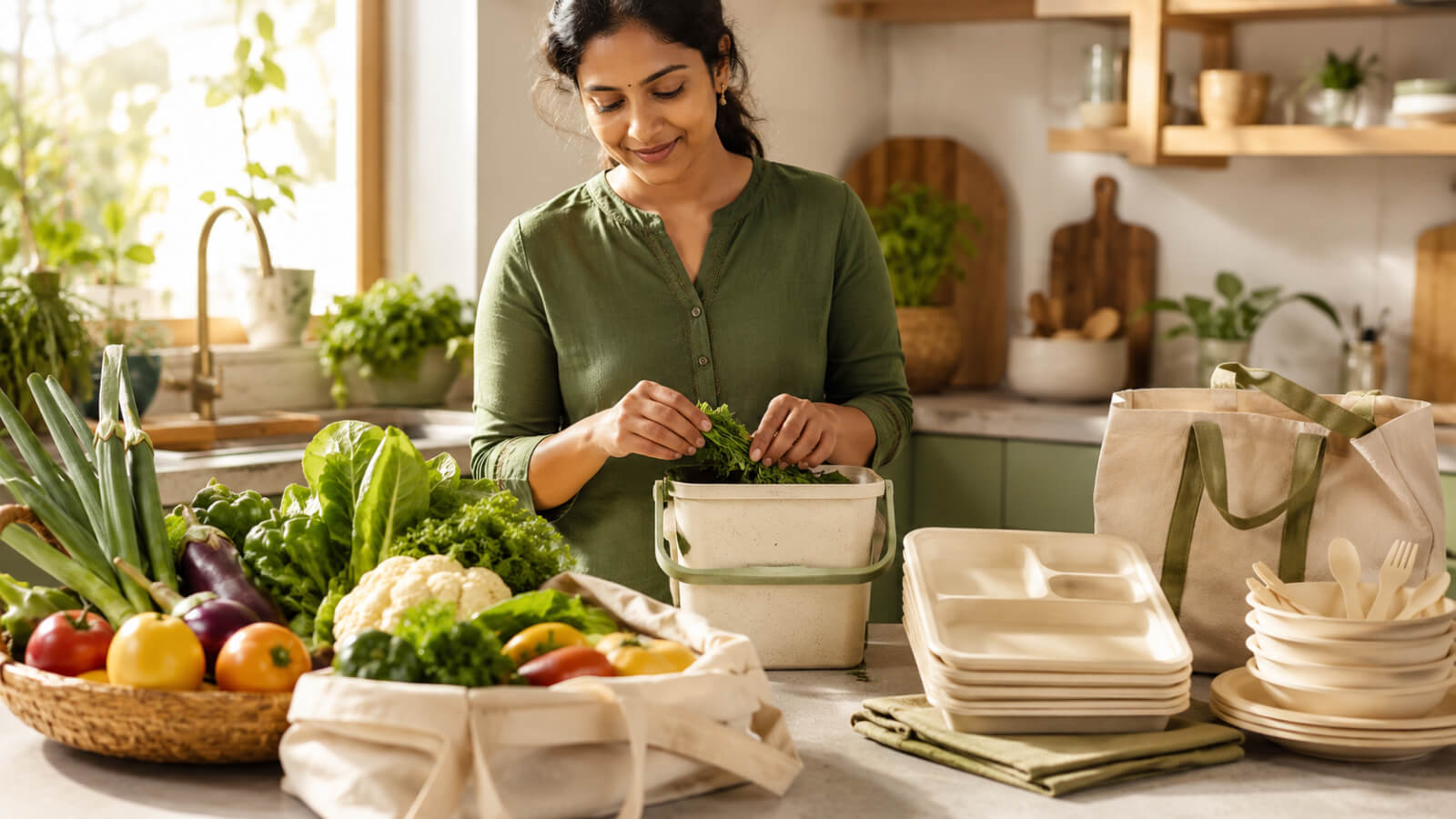
Thali & Dona: Traditional Indian Tableware in Bagasse
The thali and the dona are India's original disposable tableware formats — leaf, copper, banana stitched together with bamboo. The bagasse versions keep the form and add scale, certifications, and 60-day home compostability.
Before there were plastic plates, India had two universal disposable-meal vessels: the thali (a partitioned platter, traditionally steel for daily use and copper or silver for ceremonial occasions) and the dona (a leaf cup, stitched from dried sal or banyan leaves with thin bamboo pins, for prasad and chaat). One has scaled into the bagasse era through institutional momentum; the other through a fibre that holds its shape.
This post is the cultural-context piece — what the thali and dona actually are, how they've been served for centuries, and what changes (and what doesn't) when the material switches from leaf to bagasse.
The thali, briefly
The Indian thali (literally "plate" in Hindi) is a metal or fibre platter with multiple raised compartments — typically 6, 7, 9, or 13 — for serving a complete meal in a single vessel. Different regions have different canonical formats:
- Gujarati thali: 9-13 compartments, traditionally served on a steel plate at weddings and ceremonial meals
- Rajasthani thali: heavy-bottomed brass or copper, smaller compartments, often served on a low table
- South Indian (Tamil) thali: round steel plate with the food served on a banana leaf laid on top — the leaf is the actual disposable, the plate is reusable
- Bengali thali: traditionally served on a banana leaf (no metal plate), with separate bowls for each item
- Punjabi thali: bigger compartments, fewer of them — often just 3-4 for hearty main-portions
The 9-compartment format is the most widely served standard for wedding catering and temple langars. PulpyWare's 9-compartment round meal tray (42 g, 500 pcs/carton) is the bagasse version of this canonical format.
The dona, briefly
The dona (also called pattal or patra in some regions) is a cup-shaped vessel made by stitching dried palm leaves with thin bamboo pins. It's been used for centuries for:
- Prasad distribution at temples — small portions of sweet or rice handed to devotees
- Chaat counters — pani puri water, sev puri, bhel puri portions at street-food stalls
- Festival meal services — small snack-sized portions of jaggery rice, kheer, or dry fruit
The leaf-and-bamboo construction is itself a piece of engineering — the bamboo pins are thin enough to disintegrate during composting (they're not synthetic), and the leaves are pressed/stitched in a way that holds liquid for the duration of a single serving. Made entirely from foraged or fallen plant material, the dona is the original net-zero disposable.
What changes when bagasse takes over
Both the thali (in disposable form) and the dona have been increasingly bagasse-moulded over the past decade, for two practical reasons:
Scale. A leaf-and-pin dona producer is a cottage workshop. A wedding caterer doing 2,000-guest events can't reliably source 8,000 leaf donas in one week; a temple distributing prasad to 50,000 devotees during a festival has to ration. Bagasse moulding is industrial — PulpyWare ships 1,000 donas per carton from a single Gujarat facility, with consistent shape and food-safety certifications across batches.
Consistency. Leaf donas vary in shape, size, and rim strength based on which leaves were available that week and which artisan stitched them. For institutional catering (hospitals, schools, airline meals), that variability is a problem — bay-volume calculations break down, packaging logistics get harder. Moulded bagasse is dimensionally identical across cartons.
What doesn't change
The two things that matter most about the traditional formats survive in the bagasse version:
Compostability. Both the leaf dona and the bagasse dona return to soil. The leaf does it faster (no moulding, just natural leaf decomposition; 30-45 days). The bagasse composts too — typically about 90 days in commercial composting, longer at home. Both are net-zero on feedstock-to-disposal lifecycle. Plastic disposables — and PE-coated paper disposables — do not have this property.
Cultural fit. A bagasse 9-compartment thali still feels like a thali. The bays are positioned for sabzi, dal, rice, roti, raita, sweet and pickle, the same way a steel thali is. A bagasse 4-inch dona still feels like a dona — the square cup-shape, the rim height, the way you can hold it from the bottom while eating chaat with the other hand. The format is preserved; the material is the variable.
The aesthetic trade-off
The honest trade-off: a leaf dona looks like a leaf. The veining is visible, the colour is leaf-green to leaf-brown, and the imperfections are part of the appeal. A bagasse dona looks moulded — uniform light-cream colour, smooth surface, dimensionally identical to its neighbours.
For weddings and ceremonial events where the leaf-natural look is part of the experience, leaf donas still win on aesthetic. For festival distributions, chaat counters, and high-volume use-cases, the bagasse version is the practical choice — and "compostable, no PFAS, FDA food-contact certified" is a different kind of premium than "stitched leaf".
When to choose which
Quick guide:
- Daily home thali, school lunch, hospital meal, airline service: bagasse meal tray (9-compartment for thali, 5-comp B2B for school/hospital, 6-comp for airline)
- Wedding catering for 500+ guests: bagasse 9-compartment thali (scale + reliability)
- Wedding catering for under 300 guests with aesthetic emphasis: leaf thali (traditional look, manageable supply)
- Daily prasad distribution at a temple: bagasse 4-inch dona (scale + consistency)
- Festival prasad / Diwali pooja at home: either — bagasse for scale, leaf for tradition
- Cloud-kitchen chaat menu: bagasse 4-inch dona (sourcing reliability is the deciding factor)
The thali and the dona aren't being replaced; the material is shifting to fit the scale of modern Indian food service. The cultural format — bays for a complete meal, a cup-shape for street snacks — is older than the country and more durable than any single feedstock.
For the SKUs themselves, see the thali collection and the dona collection. For the broader compostable-materials landscape, see the complete buyer's guide.
Ready to buy?
Browse our full product catalogue or request wholesale pricing.